

Blog
How to Choose Educational Toys for Children by Age

Educational toys can make playtime more purposeful, but the best choice is not always the toy with the most pieces or activities. A suitable toy should match the child’s age, current abilities, interests and level of supervision. It should offer an enjoyable challenge without becoming confusing or frustrating.
This guide explains how parents and gift buyers can choose educational toys in Kenya for different stages of childhood. Age labels are useful starting points, but the manufacturer’s guidance on the individual product page should always take priority.
What Makes a Toy Educational?
An educational toy gives a child opportunities to explore, practise and solve problems through play. Depending on its design, it may introduce letters, numbers, colours, shapes, matching, sorting, construction, storytelling or movement.
A good learning toy does not need to teach every skill at once. A simple puzzle can encourage observation and hand control, while a set of blocks can support building, planning and imaginative play. What matters is that the child can interact with the toy rather than only watch it.
When comparing options, look for toys that:
- Match the child’s age and current ability.
- Encourage active, hands-on participation.
- Can be used in more than one simple activity.
- Have pieces that are suitable for the child’s age.
- Include clear instructions or an easy-to-understand play pattern.
- Are interesting enough for repeated supervised play.
Educational Toys for Ages 1–3
Younger children generally benefit from simple play experiences involving movement, sound, texture, stacking and matching. Large-piece shape sorters, nesting toys, simple musical toys, push-and-pull toys and chunky puzzles can be easier for small hands to explore.
At this stage, choose products with age-appropriate piece sizes and smooth finishes. Avoid assuming that a colourful alphabet or number toy is suitable for a toddler simply because it contains early-learning content. If a set includes small removable pieces, follow its age guidance and provide close adult supervision.
Educational Toys for Ages 3–5
Preschool children may be ready for activities involving letter recognition, numbers, colours, shapes, counting, matching and sorting. They often enjoy toys that let them place pieces, compare objects and repeat familiar activities at their own pace.
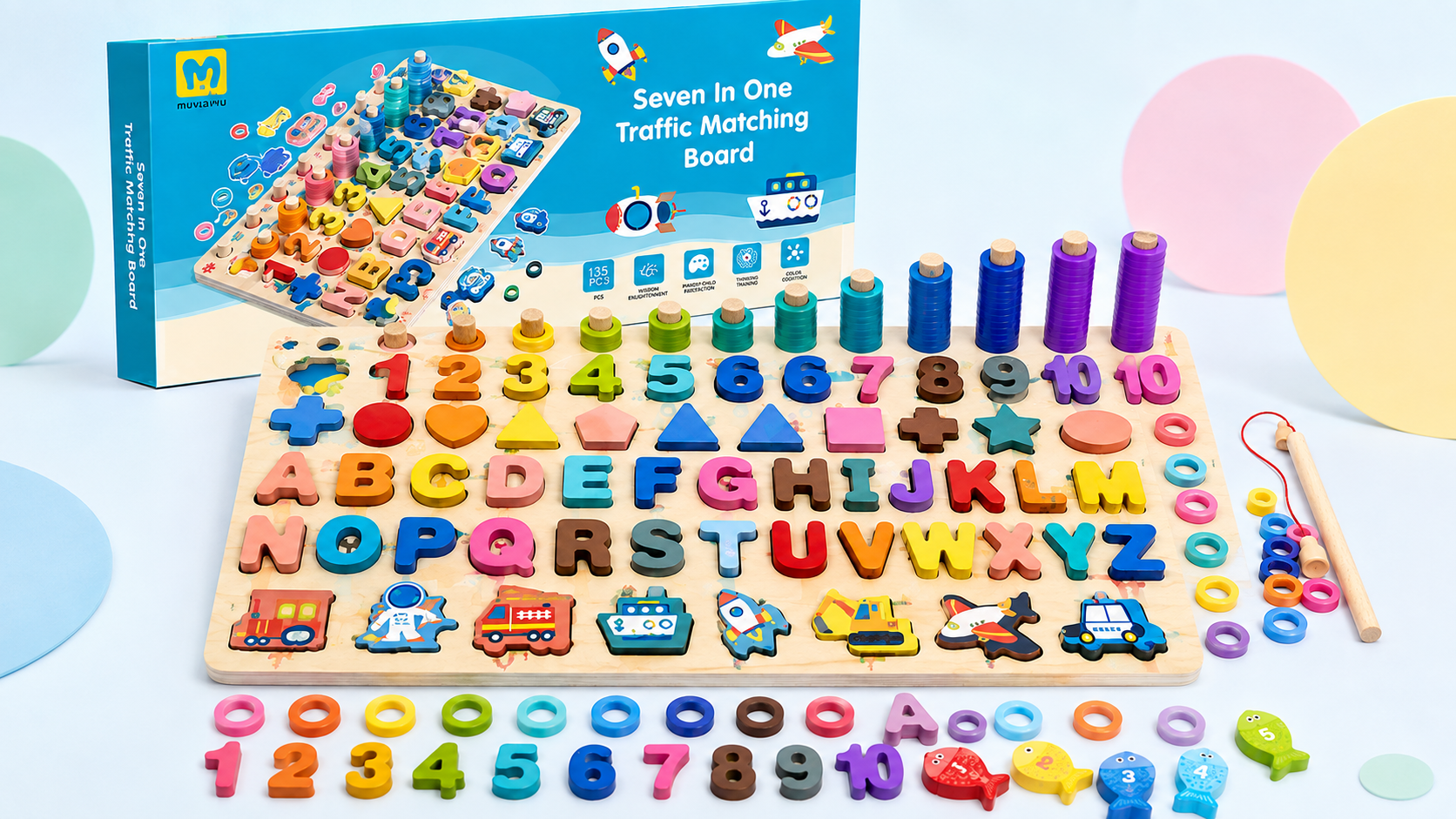
The 7-in-1 Montessori Wooden Learning Board is one example for children aged three years and above with appropriate adult supervision. It combines removable alphabet letters, numbers, geometric shapes, counting rings, sorting and picture-matching activities on one reusable wooden board.
A parent or caregiver can begin with one activity, such as identifying colours or matching shapes, before introducing alphabet order or simple counting. This helps keep the session manageable and allows the child to become familiar with the pieces.
Educational Toys for Ages 6–8
As children become more confident, they may enjoy toys that offer more complex patterns, early word-building, number exercises, construction tasks or multi-step challenges. The same learning toy can sometimes remain useful if the activities change with the child’s ability.
For example, younger users may identify individual letters and numbers, while older children may arrange letters into short words, place numbers in sequence or create supervised counting exercises. A board with several activity types can therefore support different play ideas, provided its contents remain appropriate for the child.
The Wooden Alphabet, Numbers, Shapes & Abacus Learning Board brings letter, number and shape activities together with colourful abacus beads. It is recommended for ages three years and above, and its variety can be used for supervised home, preschool or classroom learning activities.
Choose According to Ability and Interest
Children of the same age do not always enjoy or complete the same activities. One child may be interested in letters, another may prefer building, and another may respond well to colours and matching games. Consider what the child already enjoys and what type of activity will provide a reasonable next step.
If a toy is too simple, the child may quickly lose interest. If it is too difficult, adult guidance may be needed to break the activity into smaller steps. A useful educational toy should support play without turning every session into a formal lesson.
Check the Pieces, Materials and Storage
Before ordering, review the product description, photographs and included accessories. Confirm the recommended age, number and size of removable pieces, main material and any supervision instructions. For wooden learning boards, check that the pieces shown are included and that the board has a suitable place for sorting or storing them after play.
Sets containing many removable parts should be counted and stored together. This helps keep the activity organised and reduces the chance of pieces being misplaced. Adult supervision is especially important where younger children are present.
Look for Play Value, Not Just the Number of Activities
Terms such as “7-in-1” can help explain how many kinds of play a toy offers, but the number alone should not determine your choice. Consider whether the activities are suitable for the child and whether they can be introduced gradually.
A board that combines letters, numbers, shapes, counting and matching can be useful when each section is used purposefully. Start with the child’s strongest interest, demonstrate the activity, and allow time for independent exploration before introducing another challenge.
Buying Educational Toys in Kenya
When shopping online, use clear product photographs and descriptions to compare the learning activities, materials, accessories and age recommendations. Check current availability before ordering if the toy is needed for a birthday, school activity or other fixed date.
Totoland Toys offers a growing selection of educational toys, including wooden puzzles, learning boards, building toys and creative-play products. You can also browse the full toy shop and contact the Totoland team for help confirming stock, delivery and product details.
Final Checklist
Before choosing an educational toy, ask:
- Is it suitable for the child’s age according to the product guidance?
- Does the activity match the child’s ability and interests?
- Are the pieces and materials appropriate for the intended user?
- Will adult supervision be required?
- Can the toy offer more than one useful way to play?
- Have I checked the included accessories, availability and delivery arrangements?
The right educational toy should make learning feel like play. Start with age guidance, consider the individual child, and choose activities that invite participation, curiosity and repeated use.